

Primitive Reflex and Hemispheric Therapy
Primitive reflexes are the “stepping stones” of human development. These involuntary, automatic movements originate in the brainstem and are essential for a baby’s survival and neurological growth during the first months of life.
Ideally, as the higher centers of the brain (the cerebral cortex) mature, these reflexes “integrate”—meaning they are tucked away so the brain can perform more complex, intentional tasks. However, if they remain active (retained), they act like “background noise” in the nervous system, forcing the brain to work twice as hard to perform basic academic or behavioral tasks.
The Primitive Reflexes: Functions and Signs of Retention
| Reflex | Function in Infancy | Signs of Retention (The "Bottlenecks") |
|---|---|---|
| Moro (Startle) | The primitive "fight or flight" response. Helps the baby take its first breath. | Anxiety, emotional volatility, motion sickness, and extreme sensitivity to light/sound. |
| Rooting & Sucking | Helps the baby find and latch onto food. | Poor articulation/speech, messy eating, thumb sucking, and sensitivity around the mouth. |
| Palmar (Grasp) | Automatic flexing of fingers to grab an object. | Poor fine motor skills, messy handwriting, and "overflow" (tongue moving while writing). |
| ATNR (Asymmetric Tonic Neck) | Precursor to hand-eye coordination; head turns, arm extends. | Reading "jumps" on the page, poor handwriting, and difficulty crossing the midline. |
| STNR (Symmetrical Tonic Neck) | Helps the baby move from belly to crawling (cat-like position). | Poor posture (slumping), W-sitting, clumsiness, and difficulty focusing at a desk. |
| TLR (Tonic Labyrinthine) | Basis for head management, balance, and muscle tone. | Poor balance, toe walking, spatial disorientation, and difficulty with sequences. |
| Spinal Galant | Helps the baby move through the birth canal. | Bedwetting past age 5, inability to sit still ("ants in the pants"), and back sensitivity. |
Neurological Roots: Where Reflexes Live
Primitive reflexes are governed by the Brainstem, the most primitive part of our brain. As we develop, these responses are supposed to be “inhibited” by the Frontal Lobe (the brain’s CEO).
- Behavior: If the Moro reflex is retained, the brain is stuck in a state of high Cortisol, leading to impulsive behavior and a constant “alarm” state.
- Speech: Retention of the Rooting or Palmar reflexes creates a neurological link between the hand and mouth. This can cause speech delays because the muscles of the mouth are still “tied” to primitive hand movements.
- Sleep: A brain with retained reflexes never truly feels “safe.” The brainstem stays on high alert, preventing the person from reaching deep, restorative REM sleep. This often leads to night terrors or frequent waking.
Hemispheric Balance: The Left vs. Right Brain
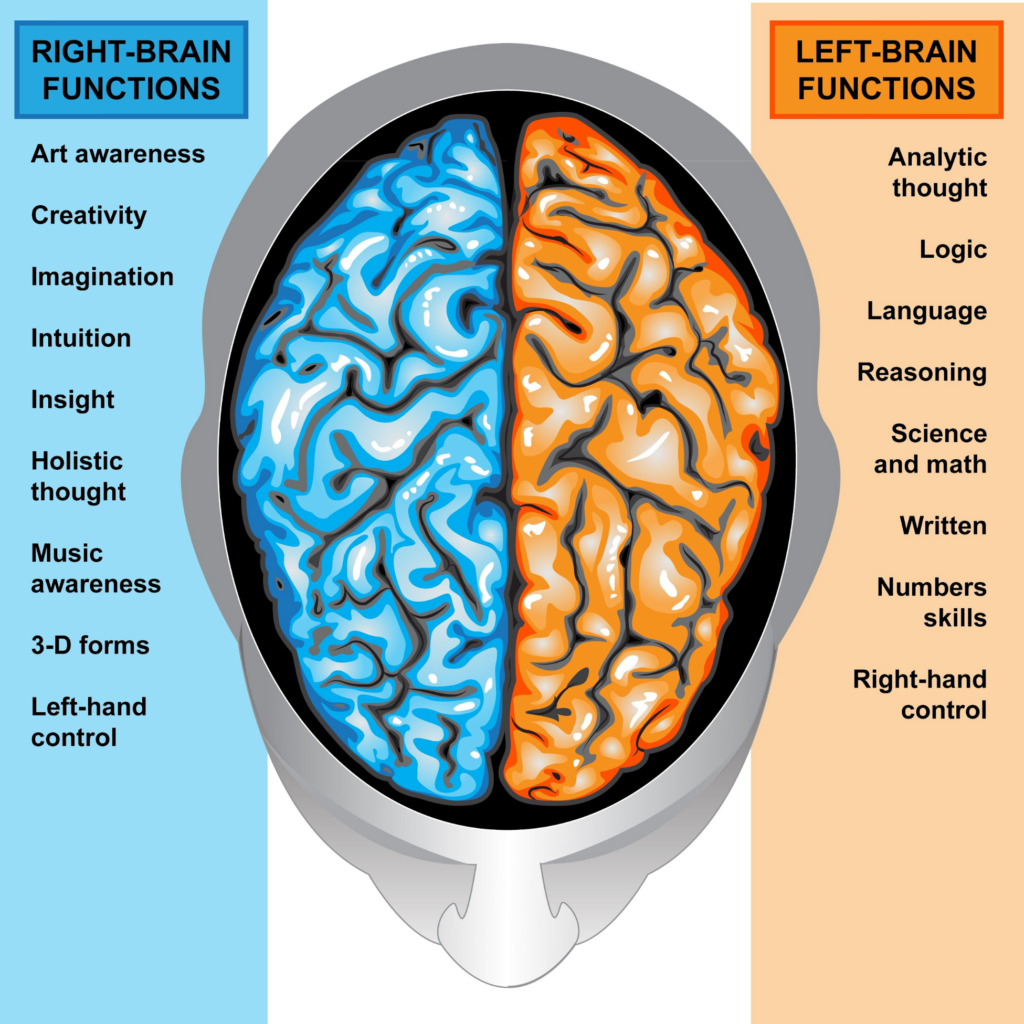
Optimal brain function depends on Hemispheric Integration—the ability of the left and right sides of the brain to communicate at high speeds via the Corpus Callosum.
The Roles Of The Hemispheres
Right Hemisphere
Big-picture thinking, social awareness, non-verbal cues, gross motor control, and emotional regulation. It is the "brake pedal" of the brain.
Left Hemisphere
Logic, details, verbal communication, sequencing, and fine motor control. It is the "gas pedal" of the brain.
What Happens During an Imbalance?
When one hemisphere is “under-active” compared to the other, the brain experiences a Functional Disconnection.
- Right Hemisphere Weakness: Often leads to ADHD, social awkwardness, and impulsivity. Since the “brake pedal” is weak, the person can’t stop their impulses or read the “room” (non-verbal cues).
- Left Hemisphere Weakness: Often leads to Dyslexia, slow processing, and difficulties with math or logic. The “gas pedal” is weak, making it hard to process sequences and detailed information.
The Maive Brain "Root Cause" Approach:
We don’t just treat the symptom; we fix the foundation.
- Reflex Integration: We use targeted physical protocols to “fold” the primitive reflexes into the brain, calming the brainstem.
- Hemispheric Rebalancing: We use advanced neuro-technologies (like specialized frequencies and visual/auditory stimuli) to stimulate the “weaker” hemisphere, bringing both sides back into sync.
- Nutritional Foundation: We ensure the brain has the amino acids and trace elements (like Zinc and Magnesium) required to build the new neural pathways created during training.
To help you identify these “neurological bottlenecks” at home or in the office, here is a detailed checklist of observable behaviors associated with specific retained reflexes and hemispheric imbalances.
Reflex Retention Checklist: What to Look For
If you notice 3 or more signs in a category, it strongly suggests the reflex is still active and interfering with the brain’s “operating system.”
The Moro Reflex (The Stress Response)
• Physical: Extreme sensitivity to sudden noises or bright lights; motion sickness.
• Behavioral: Overreacts to small changes; constant "anxiety" or mood swings.
• Work/School: Difficulty accepting criticism; gets "burned out" very quickly from sensory overload.
The ATNR (The Reading & Writing Reflex)
• Academic: Handwriting is messy and very slow; the person "hates" writing.
• Visual: Loses place while reading; eyes "jump" or skip words.
• Physical: Difficulty with "midline" tasks (e.g., catching a ball with two hands or kicking a ball).
The STNR (The Posture & Focus Reflex)
• Physical: Slumps at the desk; rests head on the hand while working.
• Academic: Difficulty copying from a whiteboard/screen to a notebook (focus change is hard).
• Habit: "W-sitting" on the floor or wrapping feet around the legs of a chair.
The Spinal Galant (The "Fidget" Reflex)
• Behavioral: Constant "ants in the pants"; cannot sit still for more than a few minutes.
• Sensitivity: Hates tight clothing or tags on shirts; back of the chair feels "irritating."
• Physical: Bedwetting past the age of 5 or 6.
Signs of Hemispheric Imbalance
A “balanced” brain is a resilient brain. When one side is significantly stronger, specific patterns emerge:
Right-Brain Weakness (The "Under-Active Brake")
• Social: Misses "sarcasm" or non-verbal social cues (body language).
• Behavioral: Impulsive; speaks before thinking; "loud" personality.
• Physical: Gross motor clumsiness; poor rhythm; struggles with big-picture concepts.
Left-Brain Weakness (The "Under-Active Gas Pedal")
• Academic: Struggles with phonics, spelling, and basic math facts.
• Cognitive: Slow processing speed; difficulty with logical sequences or "if-then" thinking.
• Physical: Fine motor struggles (using a fork, tying laces, or buttoning shirts).
How Maive Brain Corrects These Patterns
We use a Neuro-Informated Protocol that follows a strict developmental hierarchy:
- Bio-Chemical Cleanup: We check for “brain fuel” deficiencies. For example, if Zinc is
low, the brain cannot effectively prune away these old reflexes. If Amino Acids are
imbalanced, the brain stays in a “Moro-driven” state of anxiety. - Physical Integration: We use “Bottom-Up” movements. By repeating specific, rhythmic exercises, we “teach” the brainstem to hand over control to the frontal lobe.
- Hemispheric Stimulation: We use “Top-Down” technologies. This might include using flicker-frequency glasses or unilateral auditory tones to “wake up” the under-active side of the brain.
- Cognitive Strengthening: Once the hardware is stable, we use our advanced software to rebuild Working Memory and Processing Speed from the ground up.
The Advantage: Assessment allows for targeted remediation. You don’t just “teach more”; you “fix the tool” used for learning.